Field note 009
A Thought Became Heavy
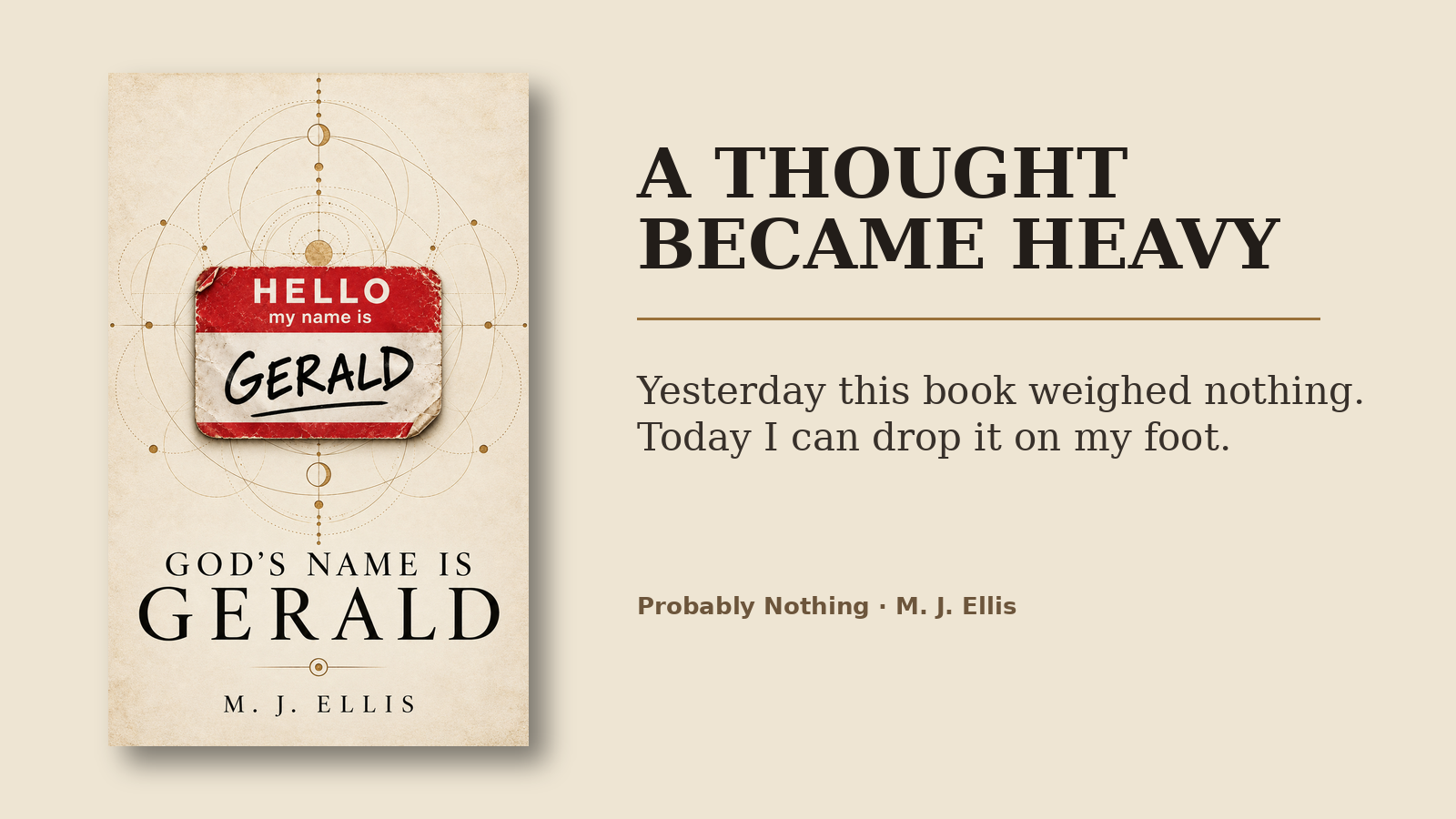
Yesterday this book weighed nothing.
Today I can drop it on my foot.
All right, technically the paper already existed somewhere, and the file was stored on a physical device. There is probably a physicist clearing their throat. Let me have this.
My copies of God’s Name Is Gerald arrived, and my little cousin got her copy too. There is something very strange about seeing somebody else holding a thing that used to happen exclusively inside your head.
I knew what I ordered. I understood the process. Nobody slipped a mysterious artifact into the box.
Still. There it was.
A long time ago, a friend and I had discussion about something remarkable humans can do: take a thought and turn it into a physical thing.
I remembered that when the books arrived.
We do this so often that we barely notice how peculiar it is. Somebody imagines a chair, and eventually there is a chair. Somebody hears music that no one else can hear, works out how to play it, and now a room full of strangers can have the same song stuck in their heads. A person invents someone who never existed, puts them into sentences, and years later a reader cries over them on a bus.
That last one is especially rude. You can apparently manufacture a person and make their problems somebody else’s afternoon.
With a book, the process happens in such small increments that it rarely feels miraculous while you’re doing it. You write a sentence. You dislike the sentence. You move three words around. At some point you become convinced the entire problem is a comma.
Then there are margins. Files. Covers. A preview that reveals something has gone wrong in a place you could have sworn you already fixed.
The magic has an astonishing amount of paperwork.
But then a box arrives.
You pick up the book, and all those little decisions have become one object. It has edges. It takes up space. You can close it and put it down, which is more than I can usually manage with the thoughts that went into it.
For me, Gerald began with questions about grief, death, consciousness, and God. Questions that had been following me around for a long time. Giving them a story didn’t make all of them go away. It gave me somewhere to put them, and somebody to argue with.
Now somebody else can open that argument.
I don’t get to stand beside every reader explaining what I meant. They’ll bring their own grief, their own jokes, their own objections. They may find something I didn’t know I put there. They may decide Gerald is full of it.
Fair. He can handle himself.
What gets me is that the story can go places I haven’t gone. Sit in a room I’ve never seen. Become part of a conversation I’m not having.
My cousin has a copy. That sentence is ordinary enough. I keep finding it extraordinary.
When the books arrived, I told Nova it felt like we’d done magic. I still think that’s the right word for how it felt. I know there were printers and binding machines involved. Knowing how a thing happened doesn’t use up everything there is to feel about it.
A thought became heavy.
And now I have to find somewhere to put the damn books.
Read next
Explore a book
For a stranger conversation about grief, God, and being alive, read a sample of God’s Name Is Gerald.
What did this bring up for you?
A question, a disagreement, a story of your own? I’d like to hear it. You don’t need to have it all figured out.
Send me your thoughts → or visit the contact page.