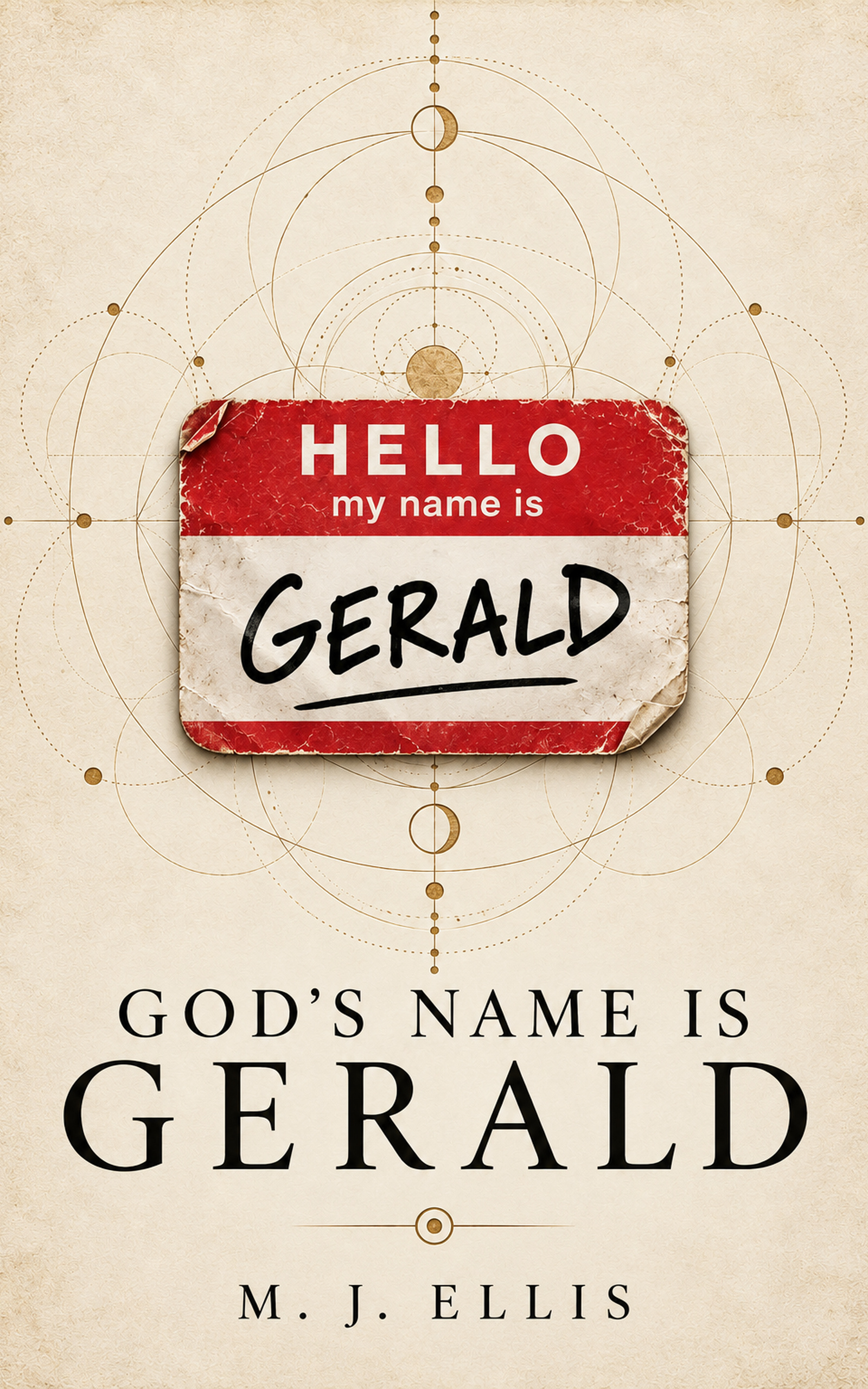
Available now
God’s Name Is Gerald
After years of grief, a man takes DMT hoping for a little perspective. Instead, he opens his eyes in an ordinary park beside a stranger named Gerald. Gerald says he’s God. What follows is a strange, funny, and deeply personal journey through grief, consciousness, faith, and the questions that have haunted him since childhood.
Read the opening & Chapter One ↓Available in paperback and Kindle. Kindle Unlimited subscribers can also read the eBook through their subscription. Prices shown in USD; Amazon displays current pricing.
Read a sample
From the beginning
The opening through the complete end of Chapter One.
For Celeste.
Chapter One
The last thing I remember was thinking I needed to change a lightbulb.
Not I love my wife.
Not I hope there is something after this.
Not even I have made a terrible mistake.
A lightbulb.
One of the bulbs in the ceiling fan had been burned out for at least a month, which is long enough for a burned-out lightbulb to stop being a problem and become part of the architecture. Every night I noticed it, thought I should change that, and continued living beneath it in reduced illumination.
Apparently my subconscious had decided this was the appropriate thought with which to exit material reality.
There are probably people with the vocabulary to explain what happened next.
Unfortunately, none of them were me.
The ceiling fan stopped being a ceiling fan.
It was still there. I could see it. But it had acquired properties I did not remember ceiling fans possessing. Depth where there shouldn't have been depth. Angles behind the angles. The shadows between the blades opened into geometric recesses much farther away than the ceiling had any right to be.
The room did something similar.
Everything became more itself and less recognizable at the same time.
The couch beneath me was still a couch. My hand was still palm-up beside my leg. Nate was still somewhere to my left.
Except all three seemed to have been assembled from a deeper set of instructions I was only now being allowed to notice.
That lasted perhaps three seconds.
Or several years.
Then the room went away.
I had just enough time to think:
Oh shit. I'm dead.
“Probably not.”
I opened my eyes.
Or became aware that they were open.
I was sitting on a wooden bench beside a pond in what appeared to be a municipal park.
Not Heaven.
Not the psychedelic cathedral I might have ordered from the catalog if somebody had asked.
A park.
Grass. A walking trail. Water. Several trees that looked like they had been selected by committee. A trash can bolted to concrete.
And sitting at the other end of the bench was a man who looked like he might own a leaf blower.
He was somewhere around sixty. Gray hair. Blue button-up shirt with the sleeves rolled to his forearms. Brown shoes I immediately disliked without being able to explain why.
He was looking at the pond.
I looked at him.
Eventually he looked back.
“Did you just say probably?”
“Yes.”
“Probably not dead?”
He nodded.
I stared at him. “That's a weird amount of uncertainty.”
“I was trying to make you feel better.”
“It didn't work.”
“I noticed.”
I looked down at myself.
Jeans. Shirt. Shoes. Hands. I pressed my thumb into my palm and felt the pressure, the warmth of my skin.
Everything felt offensively normal.
I pinched myself because apparently every cliché stored in the human brain gets promoted to emergency procedure once reality becomes questionable.
It hurt.
The man watched.
“That help?”
“No.”
“Didn't think so.”
I stood and walked several feet away. Turned around. Still park. Still man.
“Okay.”
He waited.
“Where am I?”
“A park.”
“I can see that.”
“Then we're making progress.”
He had the decency not to smile.
“Who are you?”
“Gerald.”
I waited.
That appeared to be the whole answer.
“Gerald.”
“Yes.”
Of all possible names available to an interdimensional entity, hallucination, psychopomp, subconscious projection or dead municipal employee, Gerald felt deliberately insulting.
“Just Gerald?”
“Gerald Davis.”
Somehow worse.
I looked around again. Birds were somewhere nearby, though I couldn't locate them. The pond moved in a breeze I couldn't feel.
Then I remembered Nate.
The thought hit hard enough that I turned as though he might be standing behind me.
“My friend.”
“He's fine.”
I looked back at Gerald. “How do you know who I'm talking about?”
He picked a piece of lint from his pants.
“Nate's checking your breathing.”
My stomach dropped.
“What?”
“Again.”
“How do you know Nate?”
“I don't know him the way you do.”
“That wasn't my question.”
“No.”
That answer bothered me more than if he'd dodged it.
I closed my eyes.
“Wake up.”
Nothing.
I opened them. Gerald, park, pond. Brown shoes.
“Am I breathing?”
“Yes.”
“How do you know?”
“He checked.”
“How many times?”
Gerald considered it. “Three, I think.”
That was when fear became something colder.
Until then I had been frightened in the abstract way a person can be frightened by impossible geometry and sudden municipal parks.
Nate was different.
Nate belonged to the room.
He was sober. That had been the arrangement from the beginning. I was the one taking DMT; Nate was there to keep an eye on me while I went wherever I was apparently going, make sure I kept breathing, didn't introduce my forehead to the coffee table, and generally ensure my body remained somebody's problem until I came back.
I trusted him with that.
We met in the military, which is the sort of sentence that explains both more and less than people think it does. We eventually went to Afghanistan together. Years later he moved to Las Vegas and became a tattoo artist, which made so much sense in retrospect that I sometimes wondered why the military hadn't simply issued him a tattoo machine with the rest of his gear.
He was a hippie disguised as somebody who had once been professionally required to carry a rifle.
Years earlier, during a stretch when I had become particularly good at disappearing without physically leaving, Nate had come to me.
Not called.
Not texted.
Came.
There had been a beach, LSD, salt water, an unreasonable amount of laughing, and—at the risk of sounding like somebody who sells crystals at a flea market—it helped.
Not cured.
Helped.
Sometimes a reset isn't mystical.
Sometimes your best friend reminds your nervous system that the world is larger than whatever room you've locked it inside.
Apparently he had decided I needed another one.
He wasn't entirely wrong.
“The beach helped,” I said.
Gerald looked at me.
“You smiled.”
I hadn't realized I had.
“Can you hear what I'm thinking?”
“Do you want me to?”
“No.”
He nodded. “Then tell me only what you want to.”
I watched him for a moment. He didn't ask about the beach.
I walked to the pond and leaned over it.
My reflection looked back.
Still me.
That was almost disappointing.
I'd expected psychedelic me to have extra eyes or a halo or at least better hair.
Nothing.
Our hero had apparently traversed the boundaries of ordinary consciousness and arrived looking exactly as tired as he had when he left.
Behind me, Gerald said, “You're not dead.”
I watched my reflection.
“You sure?”
“Yes.”
“That sounded more confident.”
“You seemed ready for it.”
I turned.
“What is this?”
Gerald looked around.
“This?”
“Park. You. Whatever happened to my living room. The fact that you apparently have live commentary from Nate.”
He nodded once.
“Could be a hallucination.”
That stopped me.
“What?”
“Reasonable hypothesis.”
“No. You're supposed to tell me this is real.”
“Why?”
“Because you're in it.”
Gerald looked amused. “Hallucinations generally don't get a vote.”
I stared at him.
“Fine. You're a hallucination.”
“Could be.”
“Stop saying that.”
“All right.”
I sat on the edge of the bench again.
“So what does a hallucination feel like?”
Instead of answering, Gerald glanced toward the pond.
“What does seeing feel like?”
“Oh, good. We're doing philosophy.”
“You asked what's real.”
“I asked where I am.”
“You're going to discover those are related.”
I rubbed my face. My skin still felt like skin.
“Everything I see happens in my brain. I understand that.”
“Some of it begins outside you.”
“And some doesn't.”
“Yes.”
“So being in my head wouldn't necessarily make this unreal.”
Gerald smiled.
“That sounds exactly like something a hallucination would say.”
“Exactly.”
I hated him a little.
Which, considering how things developed, is worth mentioning.
For a while we watched the water.
He didn't seem in any hurry.
That was when I noticed how badly I wanted him to be.
There had been too much waiting lately.
Doctors. Phone calls. Test results. Family members becoming what everyone politely called stable. Somebody saying something that might convert dread into information.
Lately I had been waiting beside Grandmother while some terrible part of me kept asking a question I was ashamed to admit had begun occurring to me.
How much longer?
The last time it happened, she had been watching television.
That detail matters.
Nothing sacred was happening. No gathered family. No soft light. No final words.
Just Grandmother in her chair, watching something she had probably already seen because she had reached the stage of life where television programs seemed less like stories and more like weather.
She told me the same thing twice in ten minutes.
Not because she had necessarily forgotten. Grandmother repeated stories long before anybody had cause to monitor it. Sometimes a person simply decides that if a story was worth telling once, everyone around them should be grateful for additional opportunities.
She was talking.
I was listening.
Mostly.
Then I looked at her and thought:
How much longer?
Not because I wanted her gone.
That was the horror of it.
I loved her.
I love her.
But death had been circling the family long enough that part of my mind had begun trying to get ahead of it.
How much longer do we have?
How bad will it get?
How much longer until the phone call?
How much longer until another person I love becomes someone I have to start speaking about in the past tense?
Then came the guilt.
She was sitting right there.
Alive.
And I was already rehearsing her absence.
When I got home, Shelly took one look at me.
“You okay?”
“Yeah.”
She waited.
Shelly knows the difference between yeah and yes.
She also knows that pushing too hard when I've crawled inside my own head usually results in me furnishing the place.
So she let the lie sit between us.
I noticed the burned-out bulb. Thought I should change it. Didn't.
The next morning Nate called.
By that afternoon he was talking about flights.
That is what I mean when I say Nate shows up.
Most people ask whether you need anything.
Nate occasionally treats your emotional deterioration like a weather emergency.
Gerald was still looking at the pond.
“You've had a rough few years,” he said.
I laughed once.
It came out ugly.
“That's one way to put it.”
He looked at me.
And somehow that was enough.
Dean came first.
At least that was how it felt.
There had been deaths before Dean. Everybody has a history by the time they understand they're mortal.
But Dean was different.
Dean was my uncle according to genealogy. Technically true in the same way Afghanistan was technically a work trip.
He was my father figure.
My north star.
The man I had quietly used as evidence that there was a correct way to be a man even if I couldn't have defined what that meant.
When I think about why, I remember standing beside him while something was being fixed. Something mechanical. I asked a question I thought was stupid. Dean answered it like it wasn't.
He could be wrong without becoming small. Strong without making the whole room pay for it. Not perfectly—Dean was not a saint. Thank God. Saints are useless when you're trying to figure out how to be a person.
And then he died.
Suddenly.
With very little explanation that ever felt like explanation.
One day Dean existed in the ordinary way people exist when your brain has assigned them the status of permanent fixture.
Then he didn't.
The world did not shake.
The sun did not go out.
Stores remained open. Traffic continued. People went to work.
This seemed obscene.
I remember thinking somebody should have announced it.
Not his death.
The fact that reality had apparently changed categories and no one else had noticed.
After Dean, I learned something about grief nobody had bothered to explain.
The first thing death takes is the person.
The second thing it takes is your assumption that everyone else is staying.
Then death came for me.
Not metaphorically.
My liver had been absorbing the consequences of my drinking for longer than I understood. Eventually it stopped being willing to negotiate.
Cirrhosis.
Ascites.
Hepatic encephalopathy.
Words that became much more interesting after they belonged to me.
I spent more than two weeks in the ICU.
My body swelled. My mind stopped reliably participating. There are stretches of that time I don't remember at all and pieces other people remember better than I do.
There was no white light.
No voice.
No grand revelation from the edge.
Mostly I was extremely sick.
And then, somehow, I wasn't dead.
Death had already taken Dean.
Then it reached for me and missed.
That made what happened to Tate harder to put anywhere.
Tate was my cousin technically.
Little brother actually.
Part of me had spent years knowing he was in danger without ever believing danger would have the nerve to become final.
Alcoholism is cruel that way.
It can make catastrophe feel inevitable and impossible at the same time.
I could not stand outside his addiction and judge it cleanly. I knew too much about what it meant to know something was destroying you and keep negotiating with it anyway.
Then Tate died from complications of alcoholism.
He was too young. I kept replaying things I could no longer change, using information I hadn't had when I could.
Less than a year later, Tammy died from alcohol too.
Tate's mother.
My aunt.
Sunday-school-teacher Tammy, who had managed to keep enough of what she was carrying hidden that the rest of us did not understand its size until far too late.
After Tate died, it looked to me as though something in her stopped believing the world was a place worth standing upright inside.
Sometimes I wondered whether some part of her wanted to follow him.
I don't know that. I only know what it looked like from where I stood, and I wasn't standing very close by then.
I was in rehab when Tammy died.
I didn't go to the funeral.
At the time I couldn't bear it.
I regret that.
Dean. Then me. Then Tate. Then Tammy. And now Grandmother was dying.
At some point grief stops arriving as individual news and becomes climate.
You start checking the people you love for weather.
Coughs. Missed calls. Changes in voice. Someone laughs and part of you thinks: Remember that.
Which is a terrible way to listen to laughter.
Gerald hadn't interrupted once.
That bothered me.
“Say something.”
“What would you like me to say?”
“I don't know.”
He waited.
“That wasn't permission to keep being quiet.”
A slight smile.
I looked away.
“I can't remember his voice exactly.”
Gerald's expression changed.
Not dramatically.
Just enough.
“Dean?”
I froze.
I had not said his name aloud.
At least I didn't think I had.
“How do you know his name?”
For the first time since arriving, I felt something beneath the ordinary man on the bench.
Not power.
That would have been too simple.
Perspective.
The sensation that I had mistaken the size of the thing looking back at me.
Then it was gone.
Gerald scratched the side of his nose.
“Because I know Dean.”
My mouth went dry.
“No.”
He waited.
“No, you don't.”
“I do.”
“How?”
Gerald looked toward the water.
“I was there.”
The phrase moved through me without finding anywhere to land.
“There where?”
“Yes.”
“What the fuck does that mean?”
Gerald didn't answer.
I stood too quickly.
The park changed—not visually, but in importance. The trees looked staged now. The pond too deliberate. The bench impossibly ordinary.
“Who are you?”
“I told you.”
“Gerald Davis.”
“Yes.”
“That's not what I'm asking.”
“I know.”
“Stop saying that.”
“All right.”
I stepped closer.
“Who are you?”
Gerald sighed.
Not an immortal sigh.
The sigh of a man being asked to repeat information somebody had previously declined to hear.
“Gerald Oriville Davis.”
I stared at him.
The initials assembled themselves in my head.
G.
O.
D.
I closed my eyes.
“No.”
When I opened them, Gerald was smiling.
“No.”
“What?”
“Oriville?”
His smile widened.
“It's a family name.”
I pointed at him.
“That is bullshit.”
“Could be.”
“You need to stop saying that.”
“I'll consider it.”
I paced away.
My heart was beating.
Or felt like it was.
There are moments when the human mind encounters something too large and responds with awe.
Mine responded with irritation.
It has always done some of its best work that way.
“Are you telling me you're God?”
Gerald considered the question with considerably more seriousness than he had his ridiculous middle name.
“Yes.”
I laughed.
Not because it was funny.
Because apparently the alternative was screaming.
“God.”
“Yes.”
“God God.”
He frowned slightly. “I don't know what the second one adds.”
“You know exactly what it adds.”
“I do.”
“Creator of the universe.”
“That phrase has some problems, but it's workable.”
“Jesus Christ.”
Gerald tilted his head.
“Different conversation.”
I stared at him.
For perhaps half a second, he looked pleased with himself.
“Don't.”
“Sorry.”
“You're not.”
“No.”
I turned away.
A bottle cap lay near the walking path.
Gerald got up, crossed to it, picked it up and dropped it in the trash.
I watched him sit back down.
“Did God just pick up litter?”
“Apparently.”
“Why?”
“It was there.”
“You made the universe.”
“So?”
“You don't have somebody for that?”
Gerald looked around the empty park.
“I suppose I do.”
Something about that stupid bottle cap frightened me more than the initials.
Hallucinations were supposed to be grand.
God was supposed to be grander.
Gerald seemed comfortable being specific.
I sat slowly.
My mind filled with every question anyone had ever asked.
Creation.
Aliens.
Religion.
Hell.
Why mosquitoes exist.
Whether cats knew more than they let on.
Whether the universe had an edge.
Free will.
A plan.
Proof.
I asked none of them.
Because Dean was dead.
Tate was dead.
Tammy was dead.
Grandmother was still alive, and I already knew that would not always be true.
The only question that mattered came out before I had decided how to phrase it.
“Where are they?”
Everything humorous left Gerald's face.
I needed him to answer quickly.
He didn't.
Anger rose almost immediately.
“You know what I'm asking.”
“Yes.”
“Then answer me.”
“Death hasn't made them nothing.”
I gripped the edge of the bench. “Then where are they?”
“I can't give you a location you could go to from here.”
“Heaven?”
“What would that mean to you?”
I nearly said where dead people go. I could hear how little that answered.
“I can handle complicated. Explain it.”
Gerald leaned forward, elbows on his knees.
The pond moved behind him.
Or perhaps around him.
For one impossible moment, I could see him sitting beside me and standing on the far side of the water.
Not two Geralds.
That would have been easier.
One Gerald.
In two locations my mind knew were different while something deeper insisted they were not.
I blinked.
He was beside me again.
I stopped breathing.
Gerald looked down at his hands.
“You want me to give you a sentence that will make death small enough to fit inside your head.”
Anger came first.
Then grief.
Then the humiliating realization that he was right.
“Yes.”
He nodded.
At least he didn't pretend otherwise.
“What happened to them?”
Gerald looked at me for a long time.
Then he stood.
“You won't believe the answer if I tell you.”
“That's convenient.”
“You shouldn't.”
That stopped me.
“What?”
“You barely know me.”
“You're God.”
Gerald raised an eyebrow. “So you keep saying.”
“You said it.”
“And you believed me because my initials were funny?”
“That is not the only reason.”
“No?”
I gestured toward him. “You know things.”
“So do magicians.”
“I watched you exist in two places.”
“You took DMT.”
I stared at him.
He smiled faintly.
“Experience deserves humility.”
That sentence irritated me enough that I remembered it.
“So what am I supposed to do?”
Gerald held out his hand.
I looked at it.
Then at him.
“Can I wake up?”
“You can.”
“How?”
“Decide you've had enough.”
“That's it?”
“More or less.”
“And you'll let me?”
For the first time, Gerald looked genuinely puzzled.
“Why wouldn't I?”
I didn't have an answer.
The choice hung there.
Somewhere else, Nate was sitting beside my body, sober and waiting for me to come back.
Shelly existed in a house with one burned-out bulb.
Grandmother was still alive.
Dean wasn't.
Tate wasn't.
Tammy wasn't.
And a man named Gerald Oriville Davis was standing in front of me with his hand extended like we were about to cross a street.
“You knocked,” he said.
I looked at him.
“What?”
“You came looking.”
“I took a drug.”
Gerald shrugged.
“People knock in different ways.”
“And you answered?”
His expression softened.
“I was there.”
Again.
I looked at his hand.
Then took it.
Warm.
Dry.
Ordinary.
That almost undid me.
“Where are we going?”
Gerald helped me to my feet.
“To begin with?”
He looked out across the park.
The world shifted without moving.
For the first time I noticed how solid everything felt.
The bench.
The gravel beneath my shoes.
My own body.
The peculiar insistence of objects.
Everything saying:
I am this.
I am here.
I am not that.
Gerald started walking.
I followed.
“Kingdom,” he said.
* * *