Coming December 1, 2026
The Book You Are Not Supposed to Finish
An exploration of perception, identity, time, consciousness, and meaning, built around things you can notice for yourself. Each chapter examines an ordinary assumption before the next one begins. It asks for attention and curiosity, and leaves room for you to disagree.
Read the opening & Chapter One ↓Kindle preorder is live. Paperback release is scheduled for December 1, 2026. Prices shown in USD; Amazon displays current pricing.
Read a sample
From the beginning
The opening through the complete end of Chapter One.
For the seekers.
This book was designed to be read from front to back. Each chapter changes the conditions under which the next one makes sense.
You can skip ahead.
But the last pages cannot do their work unless the earlier ones have done theirs.
Opening Warning
You are not supposed to finish this book.
Not because something will happen to you.
Because something will stop happening.
I realize that sounds like the sort of sentence designed specifically to make you keep reading.
That's unfortunate.
It's also true.
There is nothing hidden in these pages that will hurt you. No curse. No secret phrase. No thing waiting patiently for you to reach the final chapter.
You can relax about that.
Mostly.
What follows is considerably more ordinary.
We are going to look at a few things you already know.
Your eyes.
Your memories.
Time.
Other people.
Meaning.
The small fact that, at this exact moment, something is happening—and for reasons we rarely examine, you call the place where it is happening here.
None of this requires belief.
Only attention.
WHAT THIS BOOK ISN'T
Nothing inside it knows your name.
I cannot see the room you're sitting in. I cannot hear your thoughts, predict which memories will occur to you, or tell whether you just looked suspiciously at the book after reading that sentence.
If I occasionally seem to know what you're thinking, there is a simpler explanation.
People are not as unpredictable as we enjoy believing.
You are still allowed to surprise me.
This book will not reveal that you live in a simulation.
It will not tell you that you are God.
It will not tell you that everyone is secretly the same consciousness.
It will not ask you to confuse possibility with evidence, mystery with proof, or confidence with knowledge.
And when we reach something I cannot establish, I will tell you.
That matters.
Because we are going somewhere strange.
If something here disturbs you, I want you to be able to see exactly how we arrived there.
Every door we open will have been unlocked from your side.
WHAT THIS BOOK IS
We will look at those ordinary things carefully.
Then we will remove one assumption.
Not the thing itself.
Just an assumption about it.
You will probably replace it.
That's fine.
In fact, I expect you to.
I am not going to give you a new worldview. I am going to show you how much work your current one is doing.
Sometimes your replacement will hold.
Sometimes it won't.
If your answer is better than mine, keep it.
Skepticism is useful here.
So is curiosity.
Certainty is useful too, although we may want to check the receipt.
You will finish this book knowing almost everything you knew when you began.
The people you love will still be themselves.
The world will remain stubbornly present.
The facts will not change.
Their arrangement might.
That is all I am promising.
Well.
Almost.
There is one other thing.
At several points, I will tell you that you can stop.
I mean it.
All I need from you until then is enough curiosity to turn the page.
1. You Are Where You Think You Are
Look around the room.
Now close your left eye.
Hold the page at a comfortable reading distance. Keep your right eye fixed on the cross below. Do not look directly at the dot.
While continuing to stare at the cross, move the page slowly toward your face, then slowly away again. Keep the page level and keep your head still.
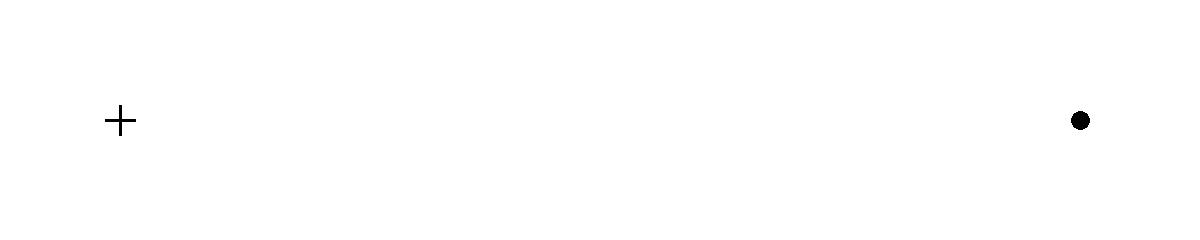
At some distance, the dot should disappear.
If it doesn't, change the distance and try once more.
If it still doesn't, don't worry. Eyes and reading distances differ. The effect is real even when a particular page does not cooperate immediately.
But if it vanished—
there it is.
Or rather, there it isn't.
You have a hole in your vision.
Not metaphorically.
Each eye contains a place where the optic nerve leaves the retina. There are no photoreceptors there: no rods, no cones, no visual information originating from that patch of retina. You have carried this absence every waking moment of your life and probably noticed it approximately zero times today.
Yet when the dot disappeared, you probably did not see a black hole, static, or a warning symbol.
The surrounding field continued through the place where the dot had been.
Open both eyes.
Look around the room again.
Nothing unusual is happening.
That is the first unusual thing.
Your other eye helps cover the missing region because its blind spot falls elsewhere. But that does not explain away what happened. With one eye closed, information really was absent from a small region of the retina, yet your experience was a continuous scene.
Researchers call this perceptual filling-in.
The name is ordinary. The phenomenon is not.
Something was missing from the incoming visual information. Your experience did not look missing.
Now, I need to be careful. It is tempting to imagine a tiny screen inside your head with a hole in it, and a microscopic artist painting over the blank spot. That is not how we know vision works. The neural mechanisms are more complicated, and researchers still debate important details.
We do not need the machinery completely solved for the strange part to remain strange.
There was no visual information from that patch of retina.
You did not experience a hole.
That happens constantly—not because your visual system is defective, but because it is good at its job.
The easiest version of this chapter would be:
YOUR BRAIN LIES TO YOU.
People love that sentence. It sounds dangerous. It is also mostly useless.
A lie requires someone to know one thing and deliberately tell you another. Your visual system is not a dishonest witness hiding the real world. It is the reason you have a visible world at all.
The problem is not that perception lies to you. "Lie" would require it to know the truth first.
Perception is not a window with dirt on it.
It is the window.
And windows frame. They admit some things and block others. They have a position. They can distort. They can be clear enough that you forget they are there.
Human vision is astonishingly good at that last one.
You do not wake overwhelmed by electrical activity, retinal circuitry, shifting light, eye movements, and competing signals. You wake up and see your bedroom.
Good.
Imagine how exhausting the alternative would be.
There is something beautiful about this. Your experience is usable, stable, and mostly continuous. You can catch a ball, recognize a face, drive through traffic, find a light switch, and notice a loved one's changing expression before they speak.
A nervous system built from living cells takes incomplete, changing sensory information and gives you a world coherent enough to live inside.
That is not a failure of perception. It may be one of the most impressive things about you.
But it creates a peculiar situation.
You never get to compare your experience with the world before experience happened to it.
You can compare perceptions, discover illusions, measure light, build cameras, examine retinas, record neurons, ask what others see, and create instruments more sensitive than your senses. All of these can show that your first impression was incomplete or wrong.
Science is extraordinarily good at this.
But when the correction arrives, it arrives as another experience.
A graph appears on a screen.
A number appears on an instrument.
A scientist explains a result.
A photograph shows what your eye missed.
The world corrects your perception by touching you again.
That does not mean there is no world outside your experience. Some of you have already begun preparing for battle:
My perception is constructed. There is still a real world outside me causing it.
Yes. Almost certainly.
Something exists independently of whether you are looking at it. Close the book and the room does not disappear. Walk outside and the building remains behind you. Other people can enter the room when you are absent and describe it later. Cameras can record events you missed.
The world is remarkably stubborn about continuing without your attention.
Good. Keep that.
But notice what you just did.
I showed you that experience is mediated. You answered by pointing to something you do not experience directly: the world as it exists independently of perception.
That may be exactly the right answer. The interesting part is that you had to make it.
Until a few pages ago, there was simply the room.
Now we have at least two things to discuss:
whatever is out there—
and what happens when it reaches you.
You live in the second one.
That sounds more dramatic than I mean it to. Your chair is still a chair. Please do not attempt to walk through a wall.
The distinction between experience and whatever produces it does not make the world unreal.
It makes experience interesting.
Everything you experience occurs inside consciousness.
For now, that is almost a boring sentence.
Everything you have ever seen has arrived this way.
Every face.
Every sunrise.
Every hospital room.
Every person you've wanted.
Every person you've lost.
The first place you remember living.
The last place you expected to be.
You have never seen any of them without seeing.
That sentence looks stupid until you notice what it means.
You cannot step outside perception to check it against an unperceived version of the world. You can only improve the methods by which the world reaches you.
And we have.
Spectacularly.
Microscopes. Telescopes. Spectrometers. MRI scanners. Radio telescopes. Particle detectors. Mathematics. Experiments. Other people checking our work.
Human beings discovered that our biological windows were limited and built more windows.
That is one of my favorite things about us.
But every window still has a view from somewhere.
And so do you.
Right now, everything visible to you is arranged around a point you almost never think about.
Here.
Turn your head.
Here moves with you.
Walk across the room.
Still here.
Fly five thousand miles.
Here.
You have never managed to arrive anywhere else.
Obviously, I am playing with language. "Here" means the place where you are. Of course it follows you.
But that grammatical fact hides something we will need later.
The world you experience is always organized from a perspective.
Not the perspective.
A perspective.
Yours.
At least, that is what we normally call it.
But "yours" has been doing more work than we have acknowledged. It has quietly turned a point of view into possession, as though the perspective belonged to someone already waiting behind it.
There is one thing you have assumed throughout this chapter without examining it.
I have talked about your eyes, your retina, your nervous system, your experience, your perspective.
And neither of us has struggled with the most important word in those sentences.
Your.
The word points toward a subject, but it does not identify one. It tells us that these experiences are being attributed to someone. It does not tell us what that someone is, where it is, or whether the thing we call "you" is as simple as the word makes it sound.
Someone has been having these experiences.
We should probably find out who.